The History of Banana Transports
Within 14-20 days from the tree to the greengrocer
Today, everyone is able to buy bananas for a small amount of money at a grocer or a supermarket. But that wasn't always so easy. During the first half of the 19th century bananas were nearly unknown in Western Europe and also in North America. Because of it's rapid ripening process, it was impossible to transport bananas over a long distance. At that time there was neither a fast service from the plantations to the harbours nor reefers (refrigerator ships) were at disposal for the transport over the sea.
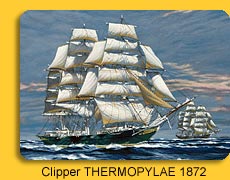 In the beginning of the 19th century tropical fruits are shipped on the
deck of sailing-vessels, because of the necessary ventilation. At convenient
seasons it was possible to use
the fast clippers to ship citrus fruits and - sometimes -
also bananas. Since the optimal temperature for shipping bananas is 13.2°C,
the loss by a premature ripening and damaging by salted water was extremely
high.
In the beginning of the 19th century tropical fruits are shipped on the
deck of sailing-vessels, because of the necessary ventilation. At convenient
seasons it was possible to use
the fast clippers to ship citrus fruits and - sometimes -
also bananas. Since the optimal temperature for shipping bananas is 13.2°C,
the loss by a premature ripening and damaging by salted water was extremely
high.
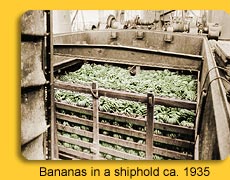 Another important requirement was a fast overland transport to the harbour,
which must not take longer than 36 hours. This was possible,
as in 1870 the first railroad tracks were build from the plantations through the
woods to the harbours.
Through the construction of freighters with thermal isolated and
refrigerator-cooled shipholds - the predecessors of the present reefers -
for the first time it was possible to ship large amounts of bananas.
So, in 1882, starts the first scheduled shipping of bananas from the Canary
Islands to Great-Britain.
But until the turn to the 20th century, citrus fruits and bananas were mostly
shipped with fruit-ships in non-cooled and only ventilated
holds.
Another important requirement was a fast overland transport to the harbour,
which must not take longer than 36 hours. This was possible,
as in 1870 the first railroad tracks were build from the plantations through the
woods to the harbours.
Through the construction of freighters with thermal isolated and
refrigerator-cooled shipholds - the predecessors of the present reefers -
for the first time it was possible to ship large amounts of bananas.
So, in 1882, starts the first scheduled shipping of bananas from the Canary
Islands to Great-Britain.
But until the turn to the 20th century, citrus fruits and bananas were mostly
shipped with fruit-ships in non-cooled and only ventilated
holds.
 The further development of the cargo vessels was a crucial requirement
for the worldwide trading of bananas.
1901 starts the regular shipping of bananas in refrigerated shipholds between
Central America and the harbours of Great-Britain.
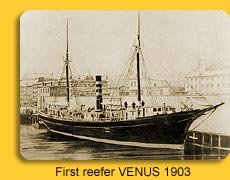
1903 the VENUS of the United Fruit Company was launched. It was the first ship,
which was especially build for the transport of bananas and ring in the age
of the reefers.
While the VENUS still had the typical black hull of this period, since 1907
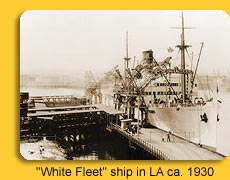
the reefers were painted with white colour to reflect the tropical sunlight
and allow banana temperatures to be more easily maintained.
As the United Fruit Company fleet of big, fast, white-painted reefer vessels
grew, they became well known as the "Great White Fleet".
Today, the United Fruit Company is known as Chiquita Brands International.
The further development of the cargo vessels was a crucial requirement
for the worldwide trading of bananas.
1901 starts the regular shipping of bananas in refrigerated shipholds between
Central America and the harbours of Great-Britain.
1903 the VENUS of the United Fruit Company was launched. It was the first ship,
which was especially build for the transport of bananas and ring in the age
of the reefers.
While the VENUS still had the typical black hull of this period, since 1907
the reefers were painted with white colour to reflect the tropical sunlight
and allow banana temperatures to be more easily maintained.
As the United Fruit Company fleet of big, fast, white-painted reefer vessels
grew, they became well known as the "Great White Fleet".
Today, the United Fruit Company is known as Chiquita Brands International.
 Interrupted by two world wars, the mechanical refrigeration of shipholds was
further developed and more and more ships were equipped with them. But the
imported exotic fruits were for many decades so expensive, that the
majority of people was not able to afford them. First, after 1950, because of
large scale cultivation and falling of shipping costs, bananas
became a natural food for the people in Western Europe.
Interrupted by two world wars, the mechanical refrigeration of shipholds was
further developed and more and more ships were equipped with them. But the
imported exotic fruits were for many decades so expensive, that the
majority of people was not able to afford them. First, after 1950, because of
large scale cultivation and falling of shipping costs, bananas
became a natural food for the people in Western Europe.
For a long time the railroads were the most important transportation for
bananas on their trip to the coast. Today in Central and South America,
thousands of cardboard boxes with bananas will be transported daily
from the packing stations to the harbour by railway or, if regular roads
are available, by modern refrigerator vans within 24 hours. There they were
loaded in modern and fast reefers to provide that bananas will be always
available all over the word.
These modern reefers have only little in common with the early bananaboats.
With their efficient refrigerators they are able to keep the bananas
at exactly 13.2°C in a state of rest, where the ripening is nearly stopped.
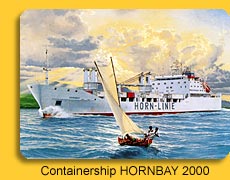 The increasing use of containers leds to the development of the first
refrigerated container ships in 1973, with the advantage
of a quicker load and unload. The containers could be directly reloaded
on trucks. These trucks transports the bananas to the ripening plants,
where they arrive in dark green colour. In a ripening chamber they will
getting "sales-ripe" within 4-8 days at a temperature between 14.5 and 18°C
advanced by adding ethylene gas to the atmosphere. Normally this is a
"medium ripeness", that means, bananas are delivered - between 14 to 20 days
after harvesting - in a yellow-green condition to the grocer.
The increasing use of containers leds to the development of the first
refrigerated container ships in 1973, with the advantage
of a quicker load and unload. The containers could be directly reloaded
on trucks. These trucks transports the bananas to the ripening plants,
where they arrive in dark green colour. In a ripening chamber they will
getting "sales-ripe" within 4-8 days at a temperature between 14.5 and 18°C
advanced by adding ethylene gas to the atmosphere. Normally this is a
"medium ripeness", that means, bananas are delivered - between 14 to 20 days
after harvesting - in a yellow-green condition to the grocer.